Introduction: The Day the Accordions Stopped Turning
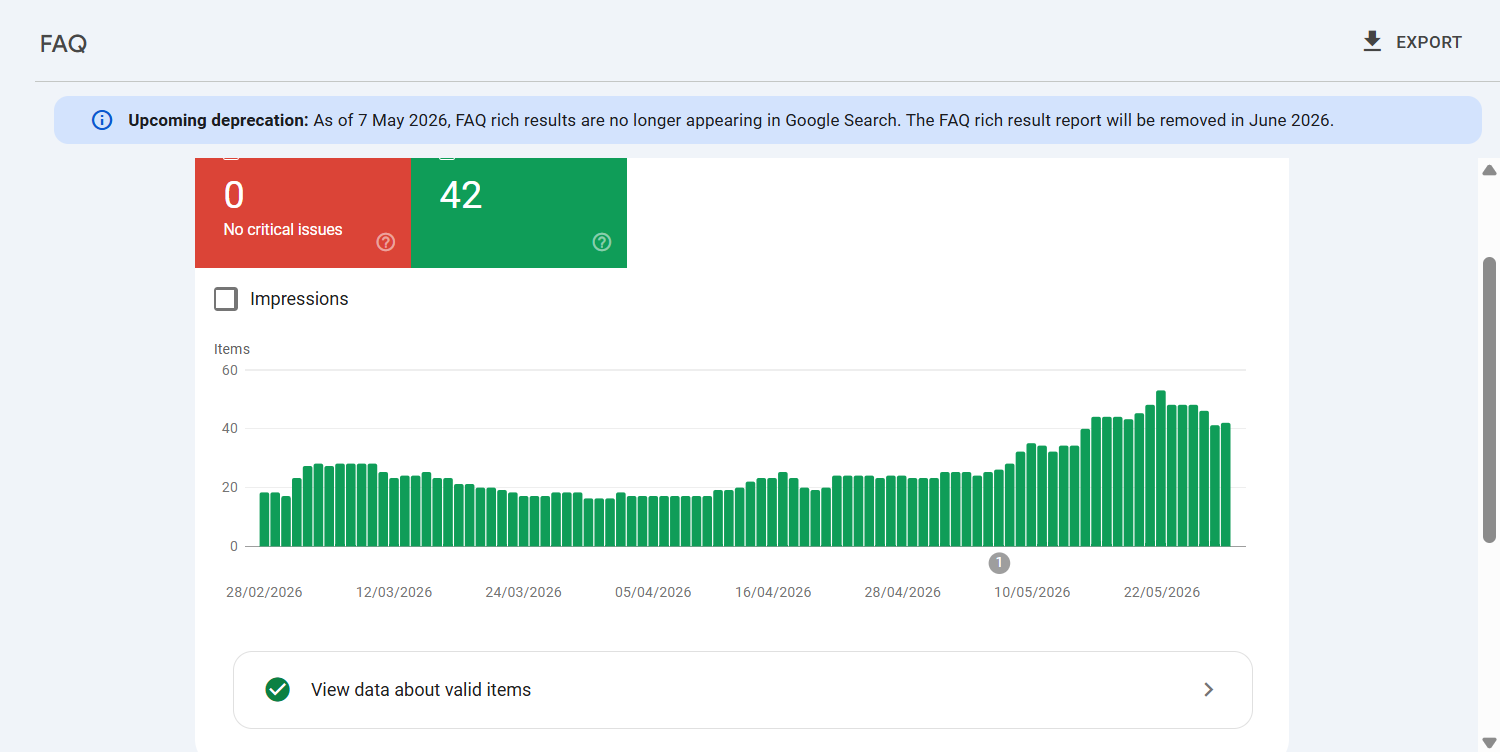
Upcoming deprecation: As of 7 May 2026, FAQ rich results are no longer appearing in Google Search. The FAQ rich result report will be removed in June 2026.
For nearly seven years, the organic search playbook had a reliable, almost universal tactical shortcut: if you wanted to dominate more physical vertical space on a Google Search Engine Results Page (SERP), you injected FAQPage structured data into your code. It was a beautiful era for search engine marketers. With a few lines of JSON-LD syntax, a standard, unassuming blue link could be instantly transformed into an expansive, interactive interface complete with expandable question-and-answer accordions.
This layout didn’t just capture attention; it aggressively crowded out competitors, pushed down local map packs, and dramatically spiked Click-Through Rates (CTR). It was a strategy deployed across every vertical imaginable from global e-commerce enterprise platforms to hyper-local restaurant websites.
However, that era has officially reached its structural conclusion.
On May 7, 2026, Google executed the absolute final phase of a rollout it had quietly begun years prior, completely halting the rendering of FAQ rich results globally for all websites. To make the burial permanent, Google announced that the FAQ Rich Result Report within Google Search Console (GSC) will be entirely deleted by June 2026, followed by the complete stripping of FAQ support from the Search Console API by August 2026.
If your digital marketing strategies, programmatic content engines, or multi-tenant SaaS marketing frameworks have been relying on automated FAQ schema injections to maintain search dominance, you are staring down a sweeping architectural shift. This comprehensive guide details why Google pulled the plug, the deep systemic impact on organic search visibility, an immediate step-by-step technical recovery pipeline, and how to successfully transition your digital assets into the next evolution of search: Generative Engine Optimization (GEO).
Part 1: Chronology of a Sunset: From Restriction to Complete Decommission
Google’s decision to sunset FAQ rich results did not happen overnight. It was a calculated, multi-stage decommissioning designed to give webmasters ample time to transition, though many ignored the early warning signs. Understanding this timeline is crucial for analyzing historical traffic anomalies within your reporting dashboards.
[August 2023] ------------------> [May 7, 2026] ------------------> [June 2026] ------------------> [August 2026]
Initial Restrictions              Global Deprecation               GSC UI Report Removed          API Support Dropped
(Limited to Gov/Health)          (Zero SERP Renderings)            (Interface Deleted)            (Code Breakage Risk)
1. The Initial Volley (August 2023)
The beginning of the end started in August 2023 when Google drastically reduced the visibility of FAQ structured data snippets. Overnight, the feature was restricted exclusively to well-known, highly authoritative government and health websites. For the commercial web, e-commerce networks, travel sites, and local businesses, the accordions vanished, causing a massive, immediate contraction in vertical SERP real estate.
2. The Final Drop (May 7, 2026)
While some SEOs clung to the hope that Google might relax these constraints, the hammer officially dropped on May 7, 2026. Google updated its core developer documentation, confirming that FAQ rich results are no longer appearing in Google Search under any circumstances. Even the legacy health and government domains that were previously grandfathered in saw their visual snippets completely stripped.
3. The Interface Deletion (June 2026)
A platform change is never fully real until the reporting infrastructure is pulled. In June 2026, Google is permanently deleting the FAQ Rich Result Report from the Enhancements tab in Google Search Console. The Rich Results Test web tool will also officially stop validating for FAQ rich result eligibility. If you attempt to test a URL with FAQ markup, the tool will simply ignore its eligibility status.
4. The API Cutoff (August 2026)
The final nail in the coffin lands in August 2026, when Google officially strips all FAQ parameters from the Search Console API. For agency leads, product owners, and data engineers managing custom data lakes, automated Looker Studio dashboards, or proprietary SEO crawling software, this is the true deadline. Any API call requesting data filtered by the FAQ search appearance dimension will break, throwing unhandled exceptions if the codebase isn’t updated.
Part 2: The Core Motivations: Why Google Killed the Accordion
To build a resilient digital marketing strategy for the future, you must understand why search engines evolve. Google didn’t deprecate FAQ rich results on a whim; the decision was driven by three massive architectural and economic realities.
1. The Rampant Over-Optimization and Spam Epidemic
When a technical optimization trick is easy to execute and highly rewarding, the global SEO community will inevitably optimize it to the point of destruction. FAQ schema became heavily abused. Content teams began using automated programmatic scripts to generate endless lists of variations of the same question, stuffing them into the JSON-LD payload of every page on a site.
Worse, many webmasters utilized “hidden” FAQ schema injecting structured data into the backend source code that was completely invisible to human users reading the actual webpage. This flagrant manipulation corrupted the purity of the search experience, transforming clean SERPs into bloated, cluttered lists of repetitive text boxes.
2. The Shift to Mobile-First Minimalist UI Layouts
As mobile devices continue to dominate global search traffic, screen real estate is at an absolute premium. An FAQ rich result block could easily consume up to 30–40% of a mobile screen’s viewport. By forcing users to scroll through massive, expandable blocks just to see the second or third organic ranking option, Google was actively degrading the mobile user experience. Streamlining the SERP layout by removing these accordions allows for a cleaner, faster, and more uniform scanning experience on small devices.
3. The Proliferation of AI Overviews and Conversation Engines
The ultimate catalyst for this deprecation is the rise of Generative AI Search primarily through AI Overviews (SGE) and conversational engines.
A traditional FAQ accordion is a rigid, prehistoric way of providing quick answers. In a landscape where advanced LLMs synthesize content from across the open web to answer highly complex, multi-layered human prompts in real-time, the need for a website to display a small, isolated Q&A accordion directly under its blue link disappears. Google has effectively taken over the role of answering immediate questions right at the top of the page, rendering the manual FAQ rich snippet completely obsolete from a user-interface perspective.
Part 3: The Technical Recovery Pipeline: Step-by-Step Fixes
Because this change is a platform-wide deprecation initiated by Google, your website isn’t suffering from an internal coding bug or a penalty. The code itself isn’t “broken.” However, “fixing” your system means executing a disciplined cleanup, backing up critical asset history, and restructuring your technical pipelines to prevent severe backend breakages before the August API cutoff.
Below is your definitive corporate checklist to execute immediately.
Step 1: Secure and Export Historical Data Before the June Wipe
Once June 2026 passes, the visual reporting interface for FAQs within Google Search Console is gone forever. You must back up this data immediately to evaluate the long-term impact on your organic performance.
[Google Search Console] -> [Enhancements] -> [FAQ Report] -> [Export CSV/Sheets]
- Log into your core Google Search Console dashboard.
- Navigate to the left-hand sidebar, scroll down to the Enhancements section, and click on FAQ.
- Analyze your historical trend lines to pinpoint exactly how many valid items your web ecosystem was running.
- Click the Export button located in the top right-hand corner of the screen.
- Download the complete dataset as a Google Sheet or an archival CSV.
Why this step is mandatory: You need this historical baseline to cross-reference with your master Google Analytics and GSC performance reports. Over the next two quarters, you must closely monitor your page-level Click-Through Rates (CTR) and total impressions on your historical top-performing FAQ URLs. If certain high-intent landing pages experience a sudden, sharp decline in traffic, it means the loss of the visual accordion has harmed your visibility. This allows you to prioritize those specific pages for deep content overhauls.
Step 2: Audit Backend Content Stacks and Remove Blocking Code
If you are managing proprietary custom CMS architectures, automated Python or Node.js content publishing tools, or large-scale multi-tenant SaaS marketing frameworks, your software development pipelines likely contain rigid schema validation mechanisms.
JavaScript
// EXAMPLE: Legacy Node.js CMS Validation Logic that MUST be modified
function validatePagePayload(pageData) {
    if (!pageData.title || !pageData.content) {
        throw new Error("Missing required fields.");
    }

    // DEPRECATION FIX: Remove or comment out strict FAQ validation requirements
    /*
    if (!pageData.schema.faqArray || pageData.schema.faqArray.length === 0) {
        logWarning("FAQ Schema missing - Content will not achieve maximum SERP real estate.");
    }
    */

    return true;
}
- Remove Strict Structural Hardcoding: Ensure your code editor or CMS input field doesn’t mandate the inclusion of FAQ data to clear a pre-publishing SEO checklist.
- Prevent Content Automation Waste: Stop running heavy internal processing routines that use AI APIs to dynamically draft JSON-LD FAQ blocks for every single newly minted URL. This wastes processing power and script execution time for a feature Google no longer renders.
Step 3: Refactor Reporting Dashboards and API Queries Before August
If your company utilizes automated data reporting systems, agency dashboards, or custom analytical software that pulls information directly from the Google Search Console API, you are facing a hard deadline in August 2026.
- Scan Your Codebase: Search through your scripts for any API calls filtering or grouping data by the
searchAppearanceparameter with a value set toFAQ. - Strip the Parameters: Proactively remove the FAQ search appearance dimension from your active JSON request payloads. If you fail to do this before August, Google’s API endpoint will reject your entire data request, resulting in broken dashboards and critical reporting downtime.
Step 4: Execute the Schema Triage Strategy (Keep vs. Delete)
A common point of confusion among webmasters is whether they need to immediately purge every line of FAQ code from their servers. The short answer is no. There is a profound difference between a Google Search UI feature deprecation and a Schema.org vocabulary deprecation.
FAQPage remains a perfectly valid, completely recognized schema classification. Google’s core parsing bots will continue to read, crawl, and analyze your JSON-LD payloads to extract contextual understanding of your webpage, even if they never render the accordion again.
Follow this straightforward triage protocol to manage your existing code:
                          Is the FAQ content visible to human users?
                                        |
                   +--------------------+--------------------+
                   |                                         |
                  YES                                       NO
                   |                                         |
     Are the questions high-quality,          [DELETE IMMEDIATELY]
     unique, and naturally written?           Remove hidden schema to
                   |                          eliminate code bloat.
          +--------+--------+
          |                 |
         YES               NO
          |                 |
     [KEEP CODE]       [CLEAN & REWRITE]
  Feeds AI models and   Streamline or remove
  Generative Overviews. thin/repetitive text.
Part 4: Shifting Resources to Active, High-Impact Schema Types
Don’t let your structured data strategy wither away just because FAQs have lost their visual luster. Instead, reallocate your technical resources and engineering hours toward schema types that Google is actively supporting, expanding, and utilizing to display rich, highly transactional data right on the SERP.
1. Product Schema (The E-Commerce and SaaS Core)
For digital products, SaaS tier matrices, and e-commerce catalogs, robust Product markup is your absolute highest priority. Google continues to lean heavily into immersive shopping experiences. By implementing deep, multi-layered product structured data, your listings remain eligible to display:
- Real-time pricing data and active price-drop alerts.
- In-stock, out-of-stock, or backorder availability indicators.
- Aggregate star ratings and direct extraction of customer review snippets.
2. LocalBusiness and Restaurant Schema (The Local Anchor)
If you manage a business portfolio with physical brick-and-mortar storefronts, your technical markup directly dictates your visibility in local map packs and localized mobile search intents. Deepening your local schema implementation feeds crucial attributes directly into Google’s primary local ecosystem:
- Exact geographic coordinates, street addresses, and hyper-precise localized operating hours.
- Direct menu digitization parameters (
hasMenu,menuItem)—vital for automated food ordering engines and restaurant discovery apps. - Explicit integration of payment options accepted, service area boundaries, and official brand entity links.
3. ProfilePage and Author Schema (The E-E-A-T Shield)
In the age of mass-produced generative content, search engines are desperately looking for anchors of human authority. Google’s implementation of the ProfilePage schema markup is designed to highlight real human perspectives.
- Use this to define your author bios, executive profiles, and subject-matter expert roundups.
- By explicitly defining social media links, corporate titles, and historical publishing credentials within the structured code, you help Google’s algorithms map your content back to a verified, highly authoritative entity. This directly strengthens your brand’s Experience, Expertise, Authoritativeness, and Trustworthiness (E-E-A-T) signals.
Part 5: Masterclass in Generative Engine Optimization (GEO)
The total deprecation of the FAQ visual snippet is an explicit signal that the search ecosystem has crossed the event horizon into an AI-first paradigm. To capture organic market share today, your optimization mindset must expand past traditional Search Engine Optimization (SEO) and fully embrace Generative Engine Optimization (GEO).
The goal is no longer about positioning your link inside a rigid list of ten blue links. The new objective is to transform your content into the primary, authoritative, and structurally flawless data source that Large Language Models (LLMs) extract, synthesize, and cite at the top of the conversational interface.
Here is the exact strategic framework required to optimize your content for the generative era:
1. Hardcode Your Content Architecture with Clean Semantic HTML
For years, digital marketers relied on backend JSON payloads to do the heavy lifting of explaining content relationships to search crawlers. Now that search engines are powered by highly advanced semantic understanding models, your on-screen content layout must be flawlessly structured for machine readability.
- Ditch the Clever Headings: Replace vague, overly creative blog section titles with explicit, naturally phrased human questions formatted clearly inside
<h2>or<h3>tags. - The Inverted Pyramid Answer Flow: Directly underneath your question heading, write a razor-sharp, highly definitive 2-to-3 sentence answer block (ideally under 60 words). Avoid fluffy introductory phrases. State the core fact or solution immediately, and then follow up with deeper explanatory text, bulleted lists, or data tables. This specific visual and textual pattern allows LLM scrapers to cleanly pull your snippet and tag it as a definitive answer source inside AI summaries.
2. Prioritize Strict “Entity-Based” Content Construction
Generative search engines do not calculate visibility based on simple keyword frequency counters. Instead, they build massive, multi-dimensional semantic graphs made up of Entities (people, places, concepts, organizations) and the Relationships between them.
- When writing authoritative content, explicitly anchor your claims using globally recognized industry terminology, official names, and verified historical statistics.
- Ensure your brand name is consistently and unambiguously associated with your primary topical niche across the entire digital ecosystem. The more reliably your business is cited alongside a specific industry concept on external authority sites, independent review nodes, and global knowledge bases, the more instinctively an AI engine will select your content as a trusted reference.
3. Build a Multi-Tenant Digital Footprint Built on Radical Authenticity
AI search engines are inherently skeptical of insular, self-hosted corporate claims. To prove to an intelligent algorithm that your website is the definitive authority on a topic, your digital footprint must extend far beyond your own domain server.
- Nurture External Validation Nodes: Actively manage and build out your presence on high-authority, third-party discussion platforms, independent consumer review ecosystems, and niche industry associations.
- The Power of First-Hand Perspective: Generative models are trained to actively seek out unique, original data points that cannot be easily replicated by an automated prompt. Inject first-hand case studies, proprietary data charts, unique corporate insights, and verified expert quotes directly into your core content strategy. This level of informational depth makes your pages uniquely valuable to an answer engine looking for original source citations.
Conclusion: Turning a Deprecation into an Unfair Advantage
The death of the FAQ rich result is only a loss for those who refuse to adapt their technical pipelines. For forward-thinking SEO strategists, agency leaders, and product innovators, this platform shift represents a massive opportunity to clear away legacy technical debt, streamline backend content engines, and build a streamlined digital footprint.
By backing up your historical data before the June deadline, auditing your automated CMS pipelines ahead of the August API cutoff, and shifting your creative focus toward semantic HTML structure and entity-focused authority, you position your digital properties to thrive. Don’t look back at the loss of the blue link accordion. Build an authoritative, deeply structured, and unforgettably authentic web presence that the generative search engines of tomorrow simply cannot afford to ignore.