Nepal election 2026 arrives tomorrow, March 5 – the first general vote since the 2025 youth-led protests toppled the previous government. With ~19 million voters heading to polls across 10,967 stations, youth turnout could reshape politics amid anti-corruption demands and 20%+ youth unemployment. Meanwhile, the escalating US-Iran war drives oil prices higher, threatening Nepal’s remittances and fuel costs. On the tech front, Apple’s MacBook Air M5 launch 2026 brings powerful AI upgrades with pre-orders live today. Full updates and analysis from Kathmandu below.
"Nepal Election 2026 Live | US-Iran War Impact | MacBook Air M5 Launch – March 4 Updates"
The world in early March 2026 feels like a pressure cooker on the verge of overflow. A rapidly escalating military conflict in the Middle East threatens global energy security and economic stability, while technological giants like Apple continue pushing boundaries in AI-powered computing. Closer to home, Nepal stands on the brink of a transformative election tomorrow March – 5 the first since youth-led protests reshaped the nation’s political landscape in 2025. This feature examines these interconnected stories in depth, exploring their immediate realities, underlying causes, potential trajectories, and what they mean for ordinary people in Kathmandu and beyond.
The US-Israel-Iran War – Day 4/5: From Targeted Strikes to Regional Inferno
The conflict that began on February 28, 2026, with coordinated US-Israeli airstrikes on Iranian targets has now entered its fifth day without any meaningful pause. What started as a focused campaign to degrade Iran’s nuclear infrastructure, ballistic missile arsenal, and command leadership has evolved into a multi-front war involving proxy forces, Gulf energy chokepoints, and fears of broader escalation.
Military updates dominate headlines. The Israeli Defense Forces (IDF), supported by US air and naval assets, have conducted over 1,000 sorties and struck nearly 2,000 targets across Iran. Recent “broad wave” operations targeted high-value sites: leadership compounds in Tehran, the Assembly of Experts building in Qom (the body responsible for selecting Iran’s supreme leader), IRGC central command headquarters, missile production facilities, and air defense batteries. Footage released by Iranian state media shows significant destruction to government buildings, including a diplomatic police center and a cultural institute in the capital images intended to rally domestic support but also underscoring the scale of damage.
Iran’s response has been asymmetric and geographically dispersed. Tehran has partially closed the Strait of Hormuz a vital artery for ~20% of global oil trade issuing threats to set fire to passing tankers. Missile and drone barrages have struck US and allied assets: the US Consulate in Dubai sustained a direct drone hit causing a massive fire (quickly contained, with no casualties reported among staff), the American embassy in Riyadh was targeted, military bases in Qatar and Kuwait faced attacks, and the port in Fujairah (UAE) suffered damage. Hezbollah, operating from Lebanon, has resumed rocket and drone launches into northern Israel, prompting Israeli ground incursions into southern Lebanon and airstrikes on Beirut-area hotels used as command posts.
US President Donald Trump has framed the operation as both defensive and decisive. In public statements, he described the strikes as “pretty substantial” and warned that “the big one is coming,” with “harder hits” yet to unfold. He reiterated US readiness to deploy Navy assets to escort tankers through the Strait and predicted the campaign could last “four to five weeks or far longer if necessary.” Conflicting rationales persist: administration officials cite preemptive action against an “imminent threat,” while others emphasize solidarity with Israel’s security needs. Secretary of State Marco Rubio warned that “the hardest hits are yet to come,” signaling no immediate off-ramp.
Casualties continue to mount. Iranian sources report over 780 – 800 deaths (military personnel, IRGC members, and civilians), with thousands displaced. The US has confirmed at least six service members killed in earlier incidents, including drone strikes in Kuwait. Civilian impacts include damage to historic and cultural sites in Tehran, raising humanitarian concerns.
International reactions reflect deep unease. Democratic US senators, after classified briefings, expressed alarm over the lack of clear endgame and fears of “boots on the ground” commitments. European allies have mobilized diplomatically (e.g., UK facilitating civilian evacuations via commercial flights), while China and the UN Security Council call for immediate dialogue. The IAEA has stated it has “no indication” of damage to core nuclear installations like Natanz, though Iran claims at least one site was hit claims that remain unverified independently.
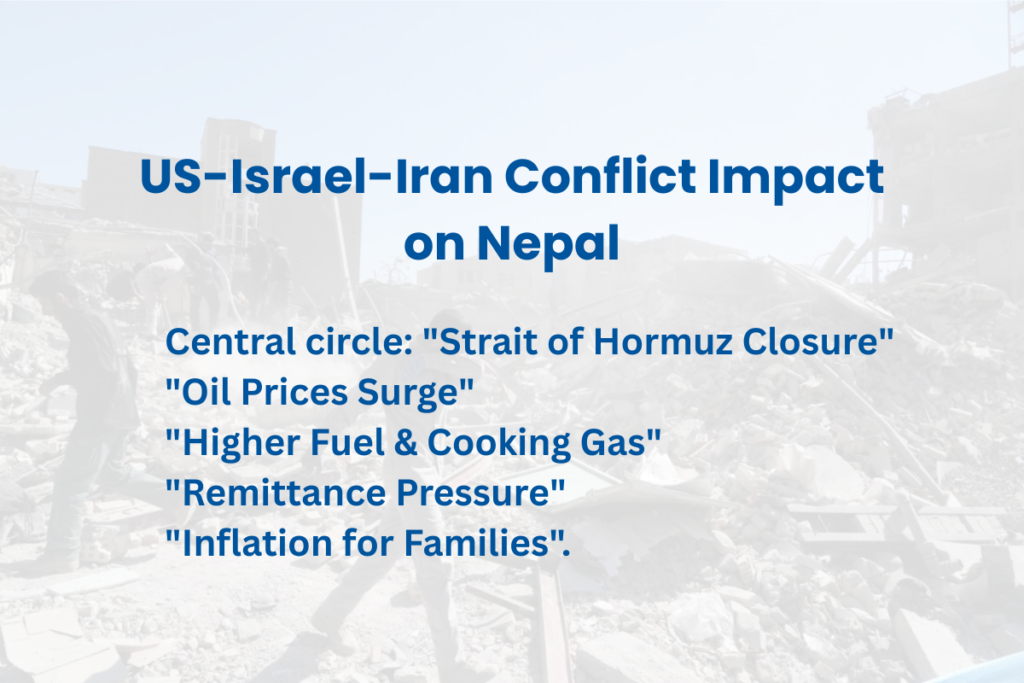
Economically, the ripple effects are immediate and severe. Oil prices have surged dramatically due to Hormuz risks, pushing global inflation fears higher and causing stock markets to slump (tech and energy sectors particularly hard-hit). For import-dependent economies like Nepal, this translates to higher fuel costs, potential increases in transportation and cooking gas prices, and pressure on remittances (a lifeline for millions of Nepali families working in Gulf countries now facing heightened instability).
Analysts from think tanks like the Institute for the Study of War note three core US-Israeli priorities: suppressing Iranian air defenses, degrading retaliatory capacity, and disrupting command/control networks. Air superiority over western Iran and Tehran has been achieved, but sustaining operations amid Iranian asymmetric responses remains challenging. The risk of miscalculation drawing in Gulf states more directly or triggering wider proxy escalation looms large. For South Asia, the war underscores energy vulnerability and the need for diversified supply chains.
Apple’s M5 MacBook Air Launch – AI-Powered Refresh in a Volatile World
Amid geopolitical chaos, innovation marches on. Apple today (March 4, 2026) opened pre-orders for the refreshed MacBook Air with M5 chip, capping a significant early-year hardware wave that includes the iPhone 17e, M4 iPad Air, and M5 Pro/Max MacBook Pro models.

The new MacBook Air retains the beloved 13-inch and 15-inch aluminum unibody design but receives meaningful internal upgrades centered on performance and AI. The star is the M5 chip: faster CPU and GPU cores, plus a next-generation Neural Engine (optimized per core for Apple Intelligence features like advanced on-device AI processing, image generation, writing tools, and workflow automation). Base storage doubles to 512GB (with configurations up to 4TB and 2x faster SSD read/write speeds), connectivity jumps via Apple’s custom N1 wireless chip (supporting Wi-Fi 7 and Bluetooth 6 for seamless, future-proof networking), and battery life reaches up to 18 hours. Other highlights include the 12MP Center Stage camera, Spatial Audio, Liquid Retina displays, and Thunderbolt 4 ports (now supporting two external displays).
Available in fresh colors sky blue, midnight, starlight, and silver the 13-inch model starts at approximately $1,099. Pre-orders are live on apple.com and the Apple Store app in 33+ countries/regions, with in-store availability from March 11. “Special Apple Experience” hands-on events are underway in New York, London, and Shanghai, generating buzz among creators, students, and professionals.
This launch arrives at a pivotal time for Nepal’s burgeoning IT and freelance economy. With software outsourcing and AI-related services approaching a $1 billion export milestone (driven by diaspora networks and domestic startups), the M5’s enhanced Neural Engine could accelerate local adoption of tools for content creation, coding assistance, data analysis, and digital marketing. Freelancers in Kathmandu, Pokhara, and beyond already leveraging platforms like Upwork and Fiverr stand to gain from faster AI workflows without cloud dependency, reducing latency and costs in a market where reliable high-speed internet remains uneven.
Broader tech trends show fierce competition keeping innovation rapid and prices accessible in segments. Nvidia’s upcoming GTC 2026 (mid-March) will spotlight agentic AI and physical robotics, while Huawei pushes AI superpods to challenge Western dominance in data centers. Yet the Middle East conflict introduces headwinds: supply chain disruptions, energy cost spikes for data centers, and equity volatility hitting chip stocks.
For Nepali users, the M5 MacBook Air represents both opportunity and reminder: technology advances regardless of global crises, but access depends on affordability, infrastructure, and skills training.
Nepal’s March 5, 2026 Election – A Youth-Driven Reckoning After 2025 Upheaval
Tomorrow, March 5, marks Nepal’s most consequential vote in recent memory: the first general election since September 2025 youth-led protests forced Prime Minister KP Sharma Oli’s resignation amid deadly unrest over corruption, inequality, and governance failures.

Nearly 19 million eligible voters will choose 275 members of the House of Representatives (165 first-past-the-post constituencies + 110 proportional representation seats) across 10,967 polling stations. The interim government, led by former Chief Justice Sushila Karki, has emphasized free, fair, and peaceful polls as the only path to legitimate stability.
The 48-hour silence period is now in force no campaigning, rallies, speeches, posters, or inducements allowed. Polling runs from 7:00 AM to 5:00 PM, with special arrangements for voters returning to home districts. The Election Commission promises results for direct seats within 24 hours of ballot collection, with full tallies following.
Over 3,400 candidates are contesting, reflecting a fragmented yet energized field. Key dynamics include:
Youth & Anti-Establishment Wave: Kathmandu Mayor Balendra Shah (Rastriya Swatantra Party) embodies Gen Z frustration with entrenched corruption and unemployment (youth rates exceed 20%). His independent-style governance in the capital positions RSP as a potential kingmaker or frontrunner.
Reform Voices: Nepali Congress figures like Gagan Thapa push progressive agendas on jobs, education, and transparency.
Veteran Forces: UML’s KP Oli seeks comeback, Maoist Centre’s Pushpa Kamal Dahal (Prachanda) leverages revolutionary credentials, but both face skepticism over past coalitions’ failures.
Likely Outcome: Coalition government almost certain no single party expected to secure majority. Post-election negotiations will determine the prime minister and policy direction.
Core issues resonate deeply: anti-corruption (spark of 2025 protests), youth employment and migration reversal, economic reform amid inflation/remittance dependence, and balanced foreign relations (India-China dynamics). The vote tests whether Nepal’s young democracy can channel protest energy into constructive governance or risk renewed instability.
For everyday Nepalis farmers in the Terai, traders in Kathmandu, migrant workers’ families the stakes are tangible: better jobs, affordable energy (especially with global oil volatility), accountable leaders, and hope for the next generation.
Conclusion: Interconnected Crises, Local Hope
March 2026 encapsulates global fragility and resilience. The Iran war reminds us how distant conflicts ripple to Kathmandu’s fuel pumps and bank accounts. Apple’s M5 launch shows technology’s relentless forward march, offering tools for Nepal’s digital ambitions. Tomorrow’s election offers a rare chance to rewrite the script youth turnout could prove decisive.
As a Kathmandu-based observer, I urge every eligible voter to participate peacefully. The future isn’t written; it’s voted on.