Introduction: The Pulse of the Himalayas
As the clock ticks toward the end of 2025, a transformation occurs in the heart of Nepal. Far from the dust of Kathmandu and the quiet trails of the Everest region, the city of Pokhara often called the “Jewel of the Himalayas” prepares for an event of seismic cultural and social proportions.
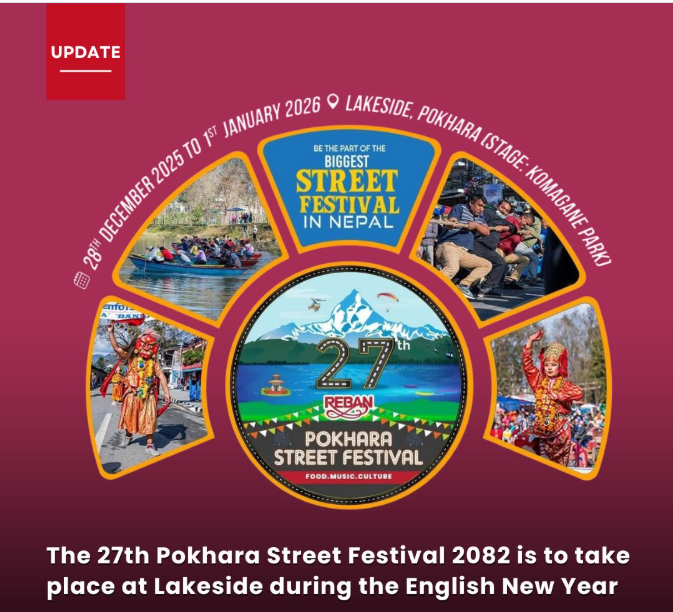
The 27th Pokhara Street Festival is not merely a party; it is a testament to the resilience of Nepali tourism and the vibrant spirit of the Gandaki province. Running from December 28, 2025, to January 1, 2026, this five-day extravaganza is the grand climax of the “Visit Pokhara Year 2025” initiative. For five days, the 3.5-kilometer stretch of Lakeside becomes a pedestrian paradise, a global kitchen, and a stage for the soul of Nepal.
Chapter 1: The Historical Evolution of a Legend
To understand the 27th edition, one must look back to 1999. At that time, the “off-season” in winter meant Pokhara’s streets were empty, and many Nepalese spent their New Year holidays in India or Southeast Asia. The Restaurant and Bar Association Nepal (REBAN) Pokhara launched a bold experiment: bring the kitchen to the street.
What started as a small gathering of local restaurant owners has grown into a national phenomenon. Today, it is credited with creating a “Reverse Migration” during the holidays, keeping millions of rupees within the local economy and attracting international travelers who seek an alternative to the crowded beaches of Goa or the neon lights of Bangkok.
Chapter 2: The Geography of the Festival (The 3.5km Walk)
The festival layout is a masterclass in urban event planning. The zone starts at Fishtail Gate (Shanti Patan) and ends at the Khahare/Gauri Ghat area.
Zone 1: The Cultural Entrance (Fishtail Gate to Center Point)
This area serves as the formal gateway. Here, you will find the largest concentration of traditional exhibitions and “Holi-day” stalls. This is where the opening ceremony takes place, featuring high-ranking officials and cultural leaders. It is more family-oriented, with traditional music playing and artisans selling their wares.
Zone 2: The Heart of the Party (Center Point to Hallan Chowk)
This is the high-energy core. If you are looking for the main stages, the heavy metal concerts, the EDM booths, and the densest crowds, this is your destination. The newly paved footpaths of 2025 have been specifically widened here to allow for the flow of hundreds of thousands of revelers.
Zone 3: The Bohemian North (Hallan Chowk to Khahare)
As you move toward Khahare, the vibe becomes “Hippie-Chic.” This area is famous for its acoustic sets, fire dancers, and lake-facing stalls. It is the best place to find a quiet corner with a craft beer or a traditional tea while watching the paragliders land in the distance during the daytime.
Chapter 3: The Five Pillars of the 27th Edition
I. Gastronomy: The World on a Paper Plate
The slogan “Eat on the Street” is taken literally. Local restaurants move their entire operations to the sidewalk.
- The Ethnic Experience: For many, the highlight is the authentic ethnic food. You can find Dhido (buckwheat porridge), Sukuti (dried buffalo meat), and Sel Roti (rice donuts) fried fresh in front of you.
- Global Fusion: Pokhara is an international hub. You will find Italian wood-fired pizzas, Korean Bulgogi, and Japanese Takoyaki, often with a Himalayan twist.
- The 2025 Sausage-Eating Contest: A new addition for the 27th edition, this event has become a viral sensation, attracting both locals and tourists to see who can handle the heat of Nepali spices.
II. Music: From Folk to Funk
Music is the festival’s heartbeat. There isn’t just one stage; there are dozens.
- National Rock: Legendary bands like 1974 AD, Cobweb, and Albatross are frequent headliners.
- The Folk (Dohori) Stage: This is where the domestic crowds gather. Dohori is a back-and-forth musical debate between men and women, often filled with wit and humor.
- Nightlife: After 9:00 PM, the street becomes a massive dance floor with DJs spinning everything from Bollywood hits to global EDM.
III. Culture: The Soul of Gandaki
The daily processions are a photographer’s dream. You will witness:
- The Lakhey Dance: Newar dancers in fierce masks and red costumes, symbolizing the warding off of evil spirits.
- Ghatu and Sorathi: Traditional dances of the Gurung and Magar communities that tell stories of ancient kings and harvests.
- The Tableau Competition: For the 27th edition, REBAN has incentivized districts to create the most elaborate cultural floats, with prizes awarded on the final day.
IV. Adventure & Sports
Pokhara is the adventure capital of the world, and the festival reflects this.
- The Waiter Race: This is perhaps the most iconic festival event. Waiters and waitresses from local restaurants race while carrying trays with drinks. It’s a test of balance, speed, and grace.
- Fewa Lake Boat Race: The colorful wooden boats (Dungas) compete in a regatta that paints the lake in vibrant hues.
- Paragliding Displays: Watch as hundreds of paragliders perform “Acro” maneuvers over the festival grounds before landing on the banks of the lake.
V. Commercial & Handicrafts
The festival serves as a massive marketplace for the Gandaki region.
- High-Altitude Products: Stalls sell organic honey from the cliffs, tea from the hills of Kaski, and coffee from the Annapurna foothills.
- Handicrafts: Look for hand-woven Pashminas, bamboo products, and intricate metal sculptures made by local artisans.
Chapter 4: The 2025 “Visit Pokhara Year” Context
The 27th edition is special because it follows Pokhara’s official declaration as the Tourism Capital of Nepal.
- New Infrastructure: The completion of major road projects and the international airport’s secondary phase has made the city more accessible than ever.
- Tourism Discounts: In an unprecedented move, over 400 hotels have joined the “20% Flat Discount” scheme for the festival week to ensure that Pokhara remains an affordable alternative to international travel.
Chapter 5: Sample 5-Day Itinerary
- Dec 28: Opening Day. Watch the massive parade from Fishtail Gate. Focus on the cultural exhibitions and the official lighting ceremony.
- Dec 29: Gastronomy Day. Spend your time “stall-hopping.” Try five different ethnic dishes. Catch the Waiter Race in the afternoon.
- Dec 30: Adventure & Art. Take a morning boat ride to Tal Barahi Temple. Spend the afternoon at the handicraft expo and the evening watching a live rock concert.
- Dec 31: The Grand Countdown. Arrive at the Lakeside early (by 4 PM). Secure a spot at a street-side table. Enjoy the fire shows and the midnight fireworks over Fewa Lake.
- Jan 1: The First Sunrise. Hike up to Sarangkot or the Peace Pagoda for the first sunrise of 2026. Return to the street for the closing awards ceremony and “Agricultural Day” displays.
Chapter 6: Practical Tips for the Savvy Traveler
1. Accommodation Hacks
Don’t just look on Booking.com. Many local guesthouses in the “Damside” or “Pame” areas offer better rates and a quieter environment. If you want to be in the middle of the action, book a hotel on the Lakeside side-streets (Gullies) to avoid the direct noise of the main stage.
2. Dressing for the Climate
The temperature difference between 2:00 PM and 9:00 PM is drastic.
- Day: Sunglasses, sunscreen, and a light T-shirt.
- Night: Thermal wear, a windbreaker, or a down jacket. It can drop to 6°C (43°F) by the lake.
3. Connectivity & Cash
- Wi-Fi: Most restaurants offer free Wi-Fi, but with 500,000 people, the networks often crash. Use a local Ncell or Nepal Telecom SIM with a 5G data pack.
- Banking: Siddhartha Bank (the official partner) will have mobile ATMs, but they often run out of cash. Carry enough NPR for the whole day.
4. Safety & Health
- Hydration: Stick to bottled water or filtered water from established restaurants.
- Security: There are police posts every 200 meters. If you lose an item, head to the REBAN information center at Center Point.
- Crowds: If you have small children, avoid the Center Point-Hallan Chowk stretch after 8:00 PM on New Year’s Eve.
Chapter 7: Sustainability – The Green Festival
For the 27th edition, REBAN has launched a “Clean Fewa, Green Pokhara” initiative.
- Zero-Waste Volunteers: Hundreds of students will be patrolling the streets to ensure trash is sorted.
- Leaf Plates: There is a push for stalls to use Tapari (traditional leaf plates) instead of plastic.
- The Lake’s Health: A portion of the festival’s proceeds goes toward the conservation of Fewa Lake and the management of water hyacinths.
Conclusion: Why This Year is Unmissable
The 27th Pokhara Street Festival is more than just a date on a calendar; it is a feeling. It is the feeling of the cold mountain air hitting your face while you hold a warm cup of Himalayan tea. It is the sound of a thousand voices counting down to midnight. It is the sight of the Annapurna mountains turning golden in the sunset as a rock band plays a legendary anthem.
In 2025-2026, Pokhara is not just a destination; it is the center of the world for five glorious days. Whether you are a local resident or a global nomad, the street is waiting for you.
Eat. Dance. Celebrate.